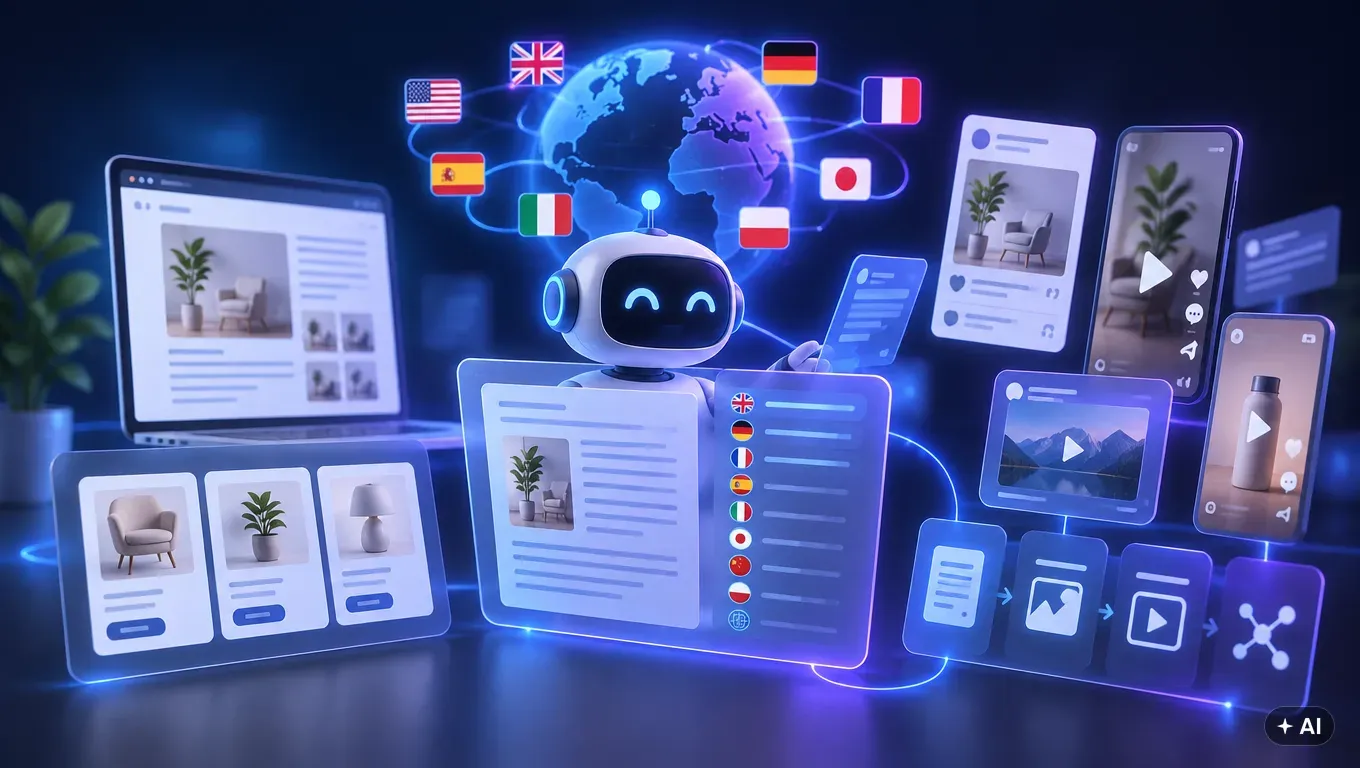
How to Effectively Create Blog and Social Posts for International Markets Without Native Speakers?
To successfully reach international customers, literally translating your domestic articles or social media posts is not enough. You need to craft content from scratch in the target language, taking into account local search queries and market-specific e-commerce nuances. You can achieve this without an expensive team of native speakers by using automated tools that generate content natively based on your product catalog data.
Cross-border expansion is a natural milestone in the growth of many online stores. The main bottleneck is rarely logistics or payment gateways; more often, it is consistent marketing communication. How can you build visibility abroad, and why does standard translation often prove to be a dead end?
Why Literal Translation Fails in International Marketing
Traditional translation typically preserves sentence structure, idioms, and thought patterns that sound unnatural to an international audience. When a user from Germany, France, or the Czech Republic lands on an article that reads like a literal translation, they lose trust in the merchant and bounce from the store.
Moreover, literal translations rarely match real search queries entered in local search engines. International customers use different terminology, seek solutions to different seasonal challenges, and focus on distinct product features. Consequently, a translated article lacks the keyword relevance that local shoppers use in Google, ChatGPT, or Google AI Overviews.
What Are the Key Challenges of Cross-Border Content Creation?
Online retailers planning regular content marketing for international markets typically face three fundamental operational and financial hurdles:
- High cost of native copywriters – rates for copywriters in Western Europe are often significantly higher, which leads to massive recurring costs when publishing multiple articles and dozens of social posts each month.
- Lack of product knowledge among external agencies – translators and local freelancers do not understand the technical nuances of your products, resulting in generic copy that fails to convert.
- Difficulty maintaining consistency – coordinating multi-language publications across your blog, Facebook, and Instagram simultaneously requires complex scheduling and continuous oversight.
Comparing Approaches: How to Manage Content Marketing in Foreign Markets
Choosing the right content creation method depends on your store's resources. The table below compares the most common operational models.
| Operational Model | Language Quality | Monthly Cost | Scalability Across Markets | Store Involvement |
|---|---|---|---|---|
| Foreign agency / native speakers | Very high, natural language | Very high, often unsustainable for SMBs | Low – each market requires a separate team and contracts | Medium – requires ongoing briefs and approvals |
| Machine translation (plugin translators) | Often unnatural, contextual and stylistic errors | Very low | High, but ignores local SEO | Low, but poses brand reputation risks |
| Autonomous AI media agent integrated with the store | High, copy written from scratch in target language | Fixed, predictable subscription | High – manage multiple markets from a single dashboard | Minimal – review ready-to-publish assets or full automation |
Writing from Scratch vs. Translating: The Role of Product Data
Generating content directly in the target language produces the strongest results in search engine optimization (SEO) and Generative Engine Optimization (GEO). Instead of translating domestic copy word for word, the raw specifications and product attributes in your catalog serve as the starting point: intended use, technical specs, key benefits, and brand identity.
From this foundation, comprehensive guides are crafted to address the exact questions international shoppers type into Google or ask AI assistants. As a result, the content is not only grammatically accurate, but substantive and naturally anchored in your store's inventory.
Media Agent AI: Multilingual Content Marketing Powered by Your Catalog
Dedicated e-commerce technology provides the answer to language barriers and runaway costs. Media Agent AI is an autonomous media agent that crafts and publishes articles, graphics, social posts, and videos based on your live store inventory.
The platform connects directly to your e-commerce system (such as Shopify, WooCommerce, Shoper, or IdoSell) and produces content in the designated target language. Crucially, Media Agent AI does not simply translate pre-existing posts. It drafts copy directly in the target language based on technical data and product attributes. Explore the platform's capabilities and review the features for international content creation tailored to your e-commerce setup.
Which Languages Can You Publish In?
Media Agent AI produces articles in any of 9 languages: Polish, English, German, Spanish, French, Portuguese, Czech, Slovenian, and Ukrainian. This selection covers major export destinations across Europe.
Crucially for social media strategy, the language for posts can be configured separately for each platform (defaulting to the blog article language). This allows you, for example, to maintain a German blog while running Instagram or Facebook campaigns in English, aligning with how you build your community.
How to Organize International Content Workflow for Your Store
To build sustainable organic visibility abroad without overburdening your team, implement a streamlined operating process:
- Step 1: Select your target market and configure the profile – determine your target country and set the primary publication language (e.g., Czech, German, or Spanish).
- Step 2: Connect your product catalog via API – the system syncs live inventory data, ensuring all published materials consistently reference in-stock products.
- Step 3: Choose your publishing mode – review and approve drafts manually in the Content Studio or enable full automation to publish on a pre-set schedule.
- Step 4: Steadily build visibility – SEO and GEO in foreign markets are long-term investments. Regularly publishing comprehensive guides steadily builds your domain authority with search engines and AI models.
Summary
- Literal translation of domestic copy fails because it overlooks local keywords, cultural nuances, and the search intent of foreign shoppers.
- Hiring native copywriters across multiple export markets incurs substantial costs that often erode profit margins.
- Effective international content marketing relies on crafting content natively from scratch, powered by accurate store catalog data.
- Media Agent AI supports 9 languages and allows you to set languages independently for your blog and social media channels.
- Consistently publishing high-value content in your audience's language is a durable investment in Google rankings and visibility across generative AI engines (ChatGPT, Gemini, Perplexity).
Frequently Asked Questions
Are German articles in Media Agent AI translated from Polish?
No. The agent writes content directly in the website language setting, crafting it from scratch using your store catalog data.
How many and which languages can you generate content in?
Media Agent AI creates articles in any of 9 languages: Polish, English, German, Spanish, French, Portuguese, Czech, Slovenian, and Ukrainian.
Can social media posts be in a different language than blog articles?
Yes. The language for posts can be configured separately for each social media channel, although it defaults to match the article language.
Who is multilingual content creation designed for?
The solution is designed for e-commerce stores and businesses expanding abroad or managing websites in foreign languages that require natural-sounding content without hiring translators or foreign agencies.